Foundations for Phonics
An early language approach to build the foundations for reading
"Reading floats on a sea of talk"
The Little Wandle Foundations for Phonics programme gives every child the best possible start to their reading journey. This builds the foundations for children to succeed with phonics in Reception.
We do this using Tuning into sounds and Rhyme time activities.
What is Phonics?
Phonics is making connections between the sounds (phonemes) of our spoken words and the letters that are used to write them down.
Research tells us that there are important skills that children need to practise to help them learn phonics. Nursery is where we practise these skills.
Phonological Awareness: being able to focus on the sounds in language, not just the meaning.
At first, when babies hear us talking, they only hear a stream of sound. However, they quickly learn to focus on the meaning of what they hear. To get children ready to read, we need to take their focus back to the sound.
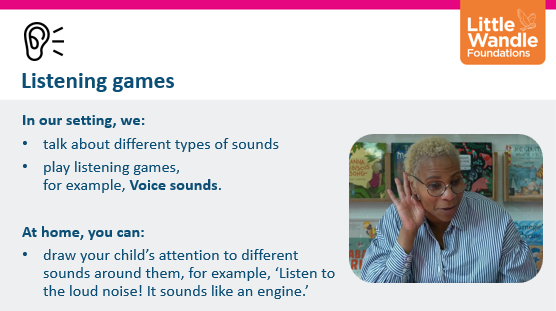
For children to learn anything well, they need to listen. As you can imagine, this is particularly true for learning to hear sounds!
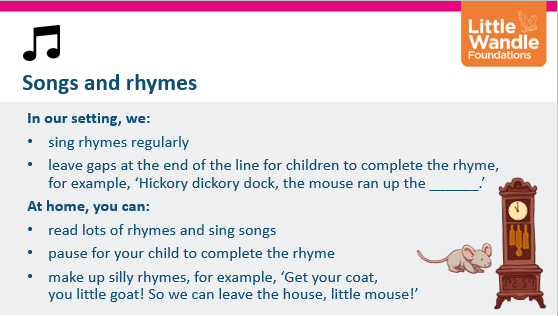
Songs and rhymes are a great way to increase children's awareness of rhyming, which is a key part of phonological awareness. What's more, research has shown that children who learn nursery rhymes with their caregivers go on to become better readers. This is only true when they learn these rhymes with an adult – please avoid only letting your child watch nursery rhymes on screens as it doesn't have the same impact.
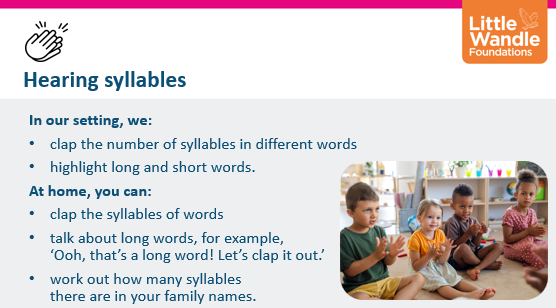
Another part of phonological awareness is syllables. Syllables are the smaller units within words. For example, the word 'hello' has two syllables – clap as you say 'hel’ and 'lo’. You can also explore the number of syllables in your names, for example, “My name has __ syllables.” (clap the syllables in your name). “How many syllables are there in your name?” If children can hear the syllables within words, it will help them to read and write longer words when they get into Reception. So it is important to give them lots of practice.
 |
 |
 |
Phonemic Awareness: being able to focus on and play around with the sounds within words.
It is really important when you support sound identification at home that you say the sounds clearly and correctly and do not show children the grapheme (letter).
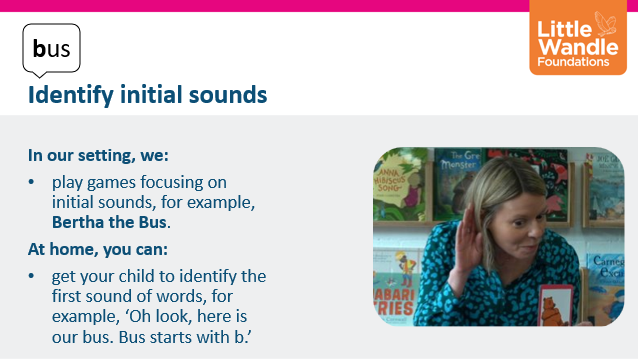
At Beechdale, we help children develop their phonemic awareness by focusing on the first sound (or initial sound) in words.
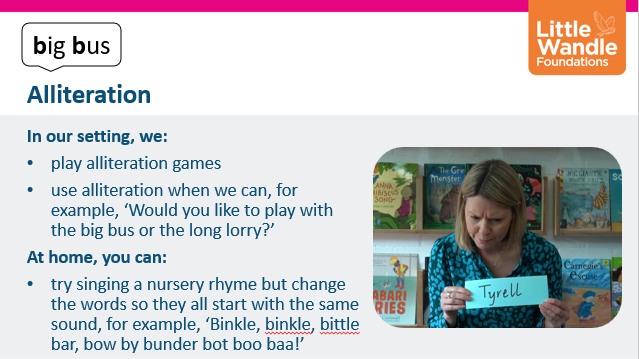
Alliteration is when words start with the same sound, for example, the big blue boat or the huge hungry horse. Alliteration helps children hear the different sounds in words and can be a lot of fun!
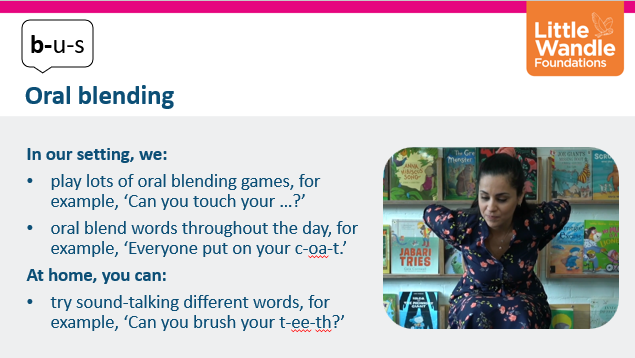
Oral blending is when we get children to put sounds together in their heads to make a word, for example, b – u – s. When children learn to read, they learn to do just this – to read the individual sounds and blend them together. Oral blending is like the dress rehearsal for reading. It is such an important skill that we do lots of practice in Nursery and would love you to practice at home.
 |
 |
 |
"Early knowledge of nursery rhymes may play a considerable role in preparing the child for reading and spelling" Bryant et al.